
Thinking and Driving
On a drive to Atlanta I pondered six years of sobriety, Joan Didion's fear of snakes, and Eve Babitz's tits.

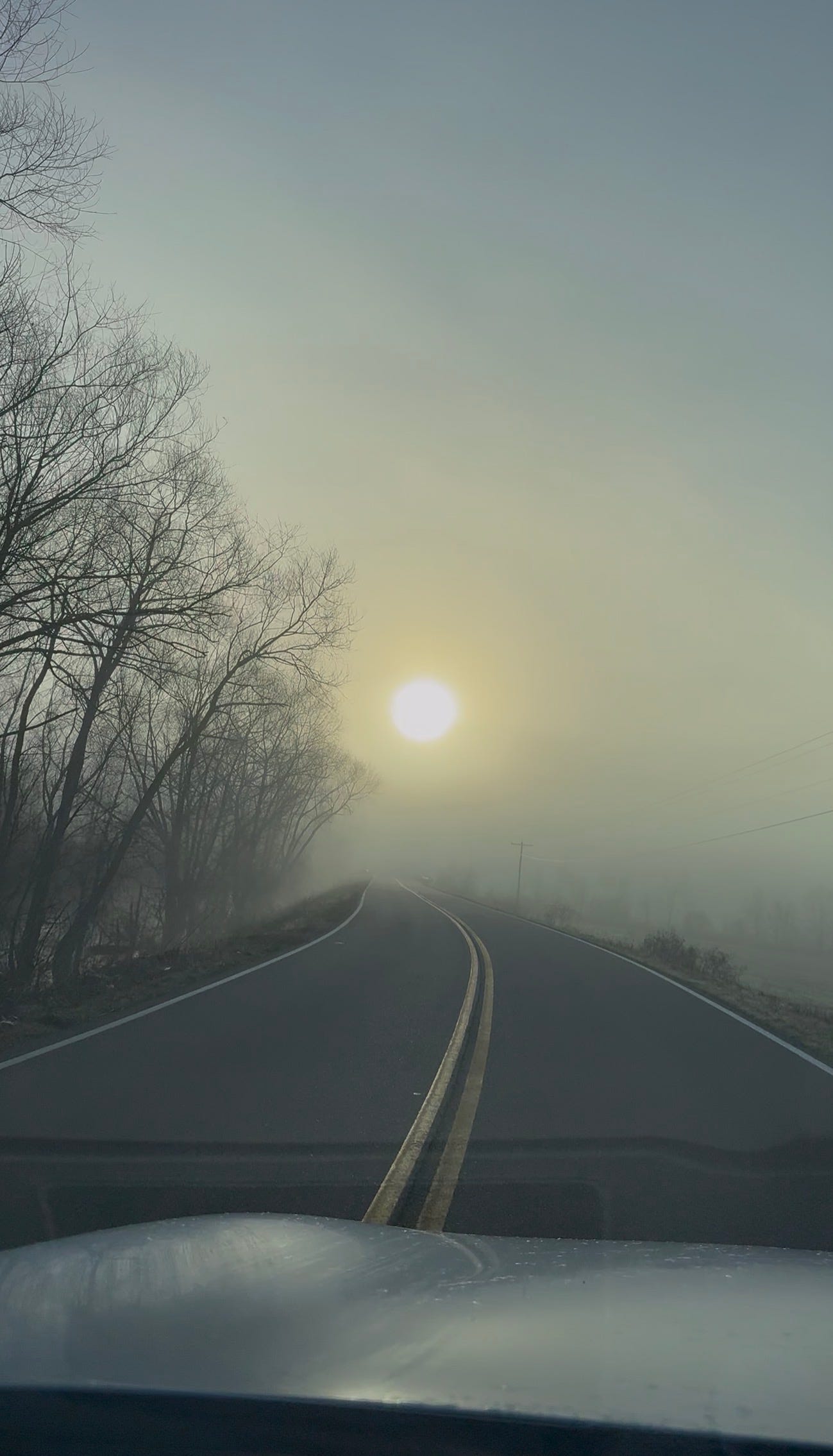
I left the container house around seven on Friday morning. There was a heavy fog and a bright sun. The combination created a sort of holy light, as if I was driving straight into heaven where Mom would welcome me with a cigarette in one hand and a coffee mug in the other.
There’s a large field that I pass on the way to the main highway. It was burned to ash a couple of summers ago, some kind of state park controlled burn, but has now produced waist-high regrowth. The fog rising up out of this resurrected wasteland threatens to reveal some kind of prehistoric creature. I briefly wonder if dinosaurs ever walked the land I now call home. I settle on no, they certainly didn’t. A more suitable stalker in this neck of the woods might be Sasquatch or a headless horseman. No doubt, that field is full of snakes.
I’m making my way to Atlanta to attend a casting for a job that six years ago I’d never have been a candidate for. My skin would have been to splotchy, my eyes too bloodshot, my body too inflamed and puffy, and my ability to show up on time too inconsistent. At forty years old and six years sober—I’m now a great fit.
I’ve been back on my Joan Didion kick after I finally conceded to reading Notes to John a couple of month ago. For the longest time I was participating in a silent protest of the book, published without consent from one of the most private writers of our time. Didion shared deeply personal anecdotes in her work but it was always in a meticulous and self-directed fashion. She opened the door into her home, marriage, and mind but what we got was a curated sample of the contents, never open range. I was particularly interested in her discussions with her therapist on alcohol abuse that I knew were in the book.
Didion was a bourbon drinker. She wasn’t a fan of twelve-step programs except for when it came to her daughter attending them who’s struggles with drugs and alcohol had never been spoken about by Didion before this book was published. Notes to John is comprised of journal entries documenting Didion’s conversations with her therapist, Dr. Roger MacKinnon, between late 1999 and 2002. Much of their time together was spent discussing Didion’s daughter, Quintana, and her alcohol abuse disorder. I believe she felt both deeply guilty about her daughter’s substance abuse and deeply resentful. I still feel uneasy about the book but I’m glad I read it. I have convinced myself that Joan Didion would have well known that any journals found posthumously would be published. I just don’t think she’d ever in a million fucking years name the thing Notes to John. Anyways, I decided to start a Didion biography audiobook on my five hour drive to Atlanta. I settled on Evelyn McDonnell’s The World According to Joan Didion.
McDonnell’s portrait of the five-foot literary icon is founded on place, more specifically the places Didion lived, frequented, and wrote about. From Sacramento to Manhattan to LA and Malibu to the Royal Hawaiian, McDonnell immerses herself in famous Didion scenes and does a nice job of analyzing without making judgements or claiming to know the unvarnished truth.
I didn’t realize how often she (Didion) used the snake motif in her writing. From Play It As It Lays to A Book of Common Prayer, Didion reveals her anxieties about lurking, unseen threats. She was terribly afraid of snakes and so am I. My nightmare is that I will wake one night to find one dangling from the ceiling over my head. Because my bed is lofted five feet off of the ground, the monster’s venomous little mouth would only be a few inches from my face. Another intrusive thought that I fight away is the image of one of those demons slithering out of my toilet or in through a tear in the screen on the kitchen window, quiet and undetected. I know I shouldn’t think about these things.
If I spend too much time thinking about snakes invading my cozy home or my family dying in a mass casualty event or cancer growing somewhere deep in my body or my friends hating me, will I create a pathway for those things to manifest? I ought to focus on love and creativity and money falling from the sky and perfectly creamy mashed potatoes and good sex at a beachfront villa. It’s hard though.
It’s human to fear and prepare for the worst—a form of protection in an unpredictable and chaotic world. Since quitting drinking, it’s much easier to imagine magically good things happening to me. My life has gotten exponentially better with every year spent sober. I’m convinced that this is not random. I’m also becoming increasingly convinced that not drinking was the key to the whole thing this whole time. Maybe there’s something transactional going on here with the universe and God above. Maybe the less I pour poison into this vessel they’ve gifted me full of tricks and gadgets the more opposite-of-poison stuff they will throw my way. Goodness, love, friendship, joy, comfort, peace, purpose, contentment, gratitude—sober me has room for it. Snakes don’t stop coming around just because you’ve cleaned the place up, though.
I took the back way into Atlanta, down to Alabama and over to Georgia, instead of the shorter drive through Nashville. I drive that stretch of I-40 three days a week and needed to mix it up. I’m irrationally afraid of bugs, so when I noticed a quick movement out of the top corner of my vision I panicked. Looking up and around my head, searching for the little fucker that was going to fly at my face or land on my arm, I nearly swerved into oncoming traffic. Somewhere near Birmingham, McDonnell mentions Didion’s friendship with writer, Eve Babitz, who could never forgive her for not reading Virginia Woolf.
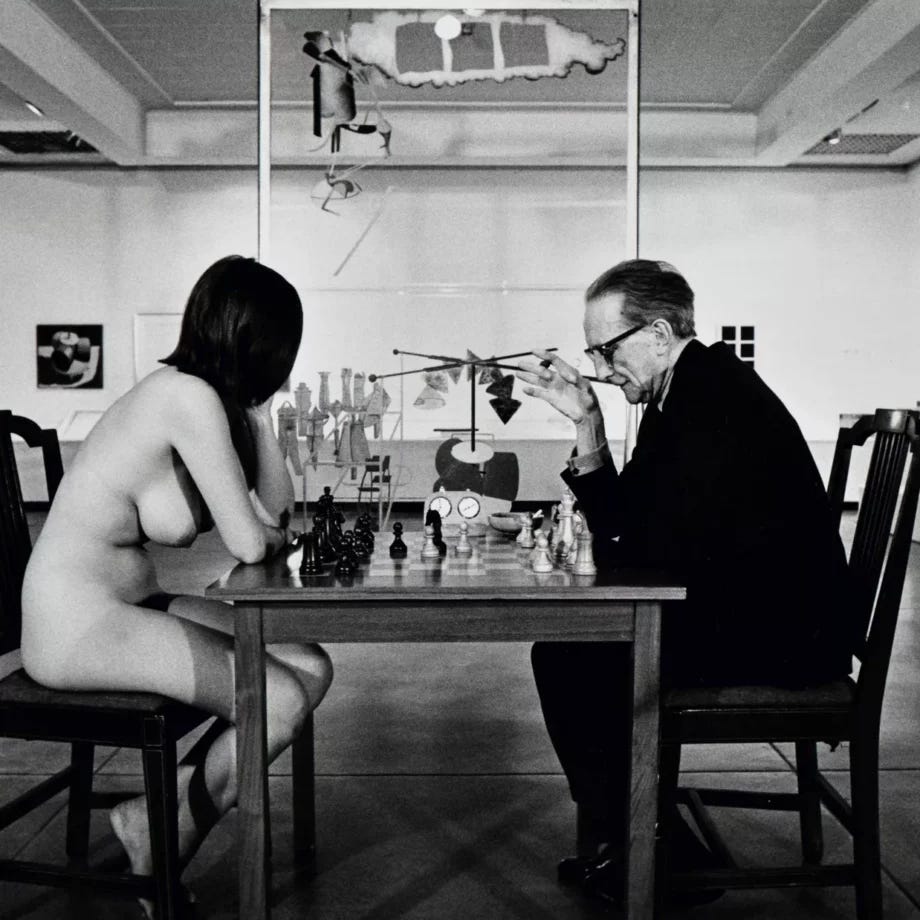
I’ll admit I didn’t know Babitz, her work, her cantankerous friendship with Didion, or that famous photo of her playing chess in the nude alongside Marcel Duchamp until I read Lili Anolik’s Didion and Babitz last year. I immediately got my hands on Slow Days, Fast Company and read it like a wide-eyed voyeur, dazzled by Eve’s confident bravado and pursuit of pleasure. She possessed both a masculine charm and a girlish, naive romanticism that intrigued me. If you haven’t read it, you should. The voice is singular, compulsory, and while abrasive and unfeeling at times, reveals a vulnerable truth that lingered with me for days. I can’t imagine Babitz fearing a few snakes in the grass. I can’t imagine her fearing much at all besides the good times ending and a weekend stuck in Bakersfield.
Babitz writes, “Deep down inside every woman is a waitress.” She tells us that it’s the perfect metaphor for women. The panic, the humility—it’s what we were sent to serve.
As I inch closer to the west side of Atlanta I ponder whether I’m more of a Didion or a Babitz. I hope I’m neither. I hope I’m both. Looking at that photo, Eve in all her womanly glory with her hair concealing her face, I concede that my body alone betrays me. My chest is flat as this highway and I’m awful at chess. It’s the perfect image of Babitz, though. Unashamed of her need to be seen, to feel pleasure, to expose herself when and where she pleased, yet hiding her face, her inner thoughts, her true identity from the audience—it’s truly one of the most remarkable photos I’ve ever seen for all of its layers.
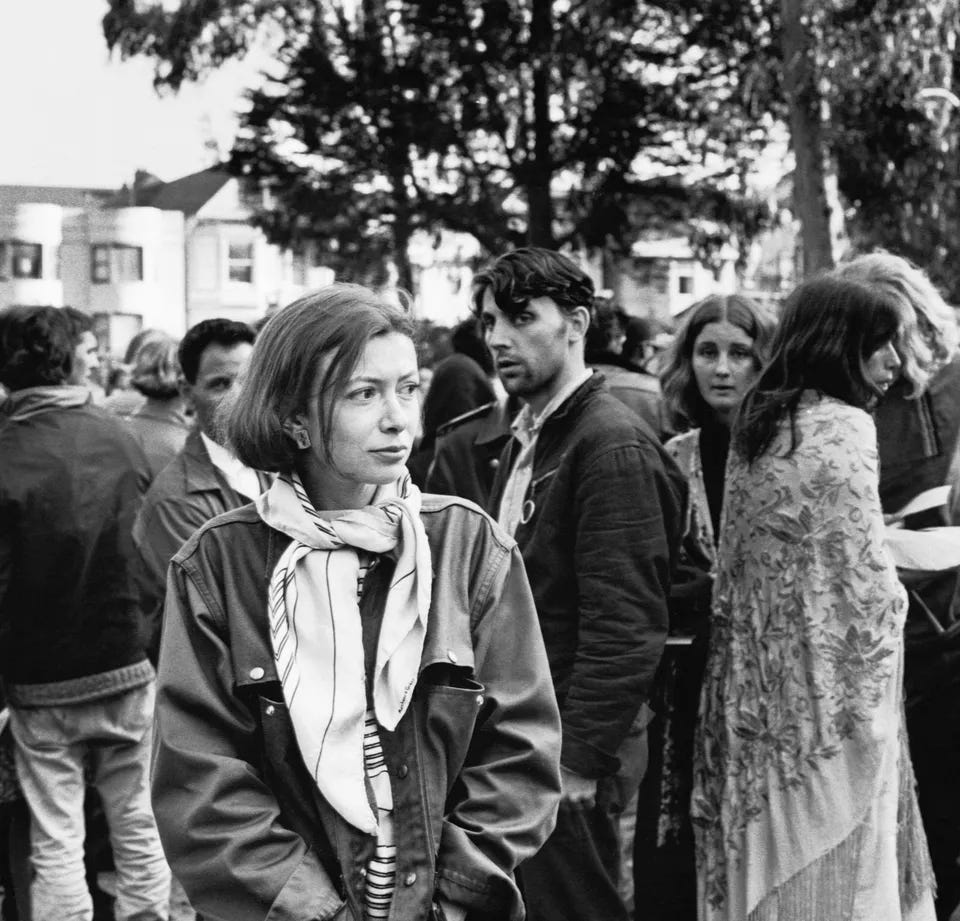
Didion couldn’t appear more opposite. In my favorite image of her, an observant Didion standing in Golden Gate Park of San Francisco in 1967 by Ted Streshinsky, the pout of her lower lip makes her look both uncomfortable and cunning. Didion is covered to the throat, a white scarf tied around her neck. I think I am more Didion-esque in the ways that I hide, always sizing up an environment, careful not to allow my presence to disturb it from its natural rhythms. But my sensitivity betrays me here. Joan could cut and slice a painful emotion with surgical precision, I let the whole thing flood the page. She could keep some of her guts to herself. I spill.
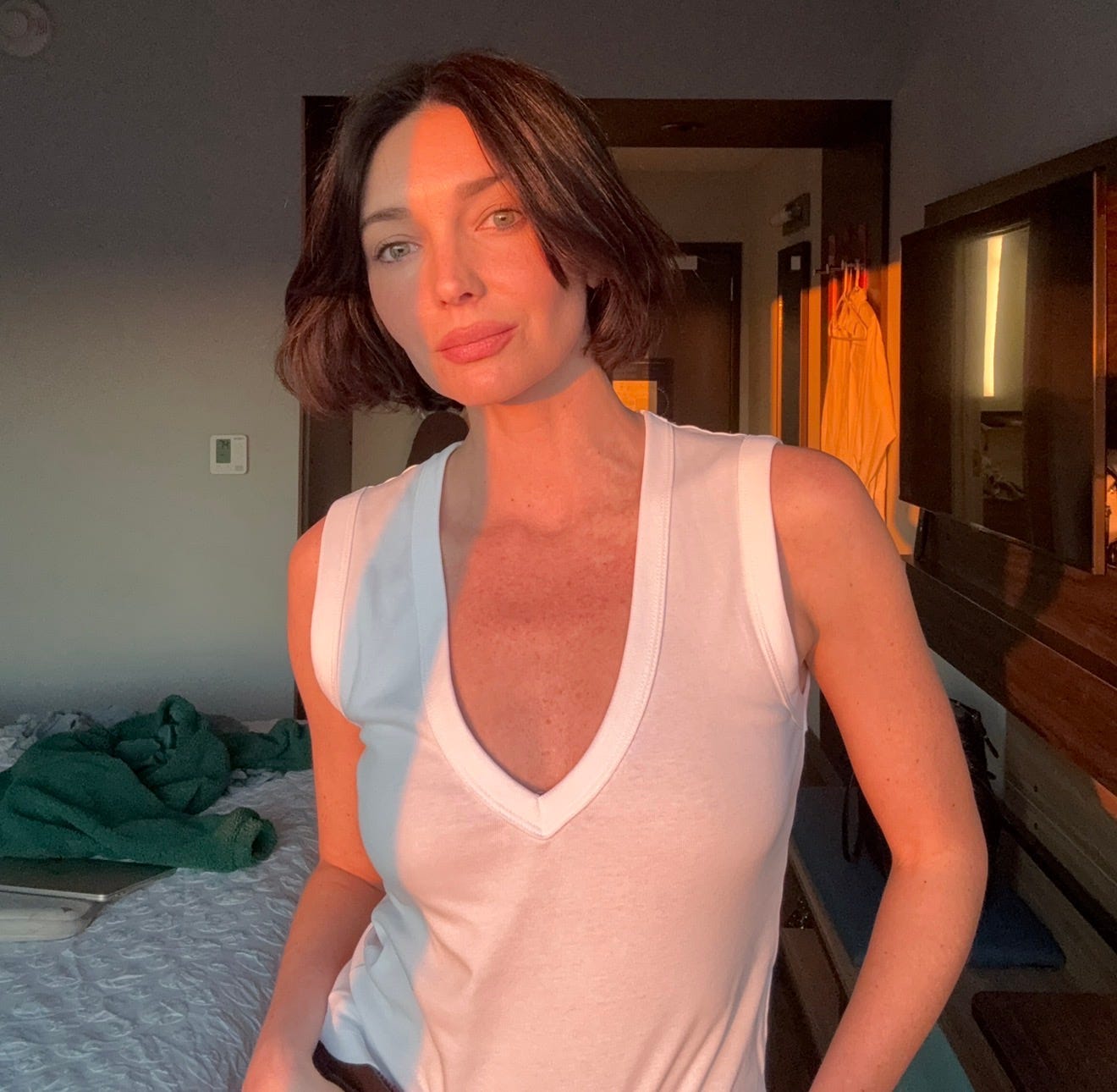
I am unique in this trio—me, Didion, and Babitz—given that I do not drink alcohol anymore. I flop down onto my bed at a mid-priced hotel in an industrial area of the city and wonder how different their work would have been without the booze, the loud parties, the fast men and Hollywood nights—would it have existed? I wonder if mine would exist without it either. I don’t think I would write if I did not have my dark stories to sift through, to pull from, to color my present portrait. I don’t think this would exist if I were still drinking either. The irony.
Joan Didion says we tell ourselves stories in order to live and Eve Babitz says that sex is art. I say it’s how we recover from both of these pastimes that is the real art and life force. It’s what we do with all that fantasy and heartbreak and denial and hunger.
If we aren’t careful, the things we are afraid of will eventually kill us. Not because they will get us like in my nightmare of the snake dangling over my face at four in the morning, but because we will be so distracted looking at that thing and afraid of what it might do that we will miss the actual threat coming from the opposite direction. In my sixth year of sobriety, I learned that the real snake is actually just the fear. That is what will trap you, dangle over your head in the dark night, and eventually kill you dead.
I made it to the job casting and they were running half an hour behind. I sat down and joined in the conversation already in progress between a handful of other models all there for the same reason. One was from Tampa, one from Charlotte, one a local to Atlanta, and one didn’t speak but instead sat scrolling on her phone until the lady called her back. When it was my turn I strode back to the studio setup and cracked a few jokes with the stylist. I don’t take any of this shit too seriously anymore and I think most people in the industry appreciate that, especially in the south. We aren’t shooting Vogue. I tripped on one of the cords from the camera and would have both face-planted and destroyed their very expensive equipment had one of the assistants not caught me with one arm around my waist before I toppled the whole thing over. I think it went well. Fingers crossed.
Wow Kristen, your writing is so original. I look forward to reading your next writing! ❤️
Kristen your writing gives me chills! I look forward so much to your musings. I too struggle with intrusive thoughts and the consequential frustration of, “but why on Earth can’t I just ruminate on wonderful things.” I’m in LA, channeling Joan today 😎